
Building between two water levels
Daycare at Baakenhafen
Hamburg’s HafenCity is one of the most impressive urban development projects in the city: since 2001, an entirely new district has been taking shape along the Elbe. The Baakenhafen is the largest harbor basin within HafenCity. The planned sustainable, urban village in the heart of the city not only provides space for various residential concepts, but also creates a complete infrastructure with an elementary school, daycare center, underground parking, and a marketplace.
Daycare at Baakenhafen – Ginger HPC in demand
Since 2014, Ginger HPC has been involved in this HafenCity project. The team initially carried out extensive geotechnical investigations and prepared a subsoil and foundation report. The site designated for the daycare center is located between the elementary school currently under construction, a residential street, apartment buildings, and a waterfront park. Under the direction of Limbrock Tubbesing, and for the client SterniPark GmbH, a daycare facility will soon be built.
The concept is ambitious: up to eight floors will be designed so that everything is housed under one roof. This includes a rooftop playground, a swimming pool in the basement with direct access to the neighboring school, a training college for educators, and a children’s restaurant. Ginger HPC is involved in multiple stages of the project—from initial ground investigations, storm surge protection, and excavation support, to groundwater lowering, pile foundation, and the complete excavation of the construction pit. The experienced Ginger HPC team provides expertise across many disciplines and advocates for sustainable construction methods.
Attention to detail
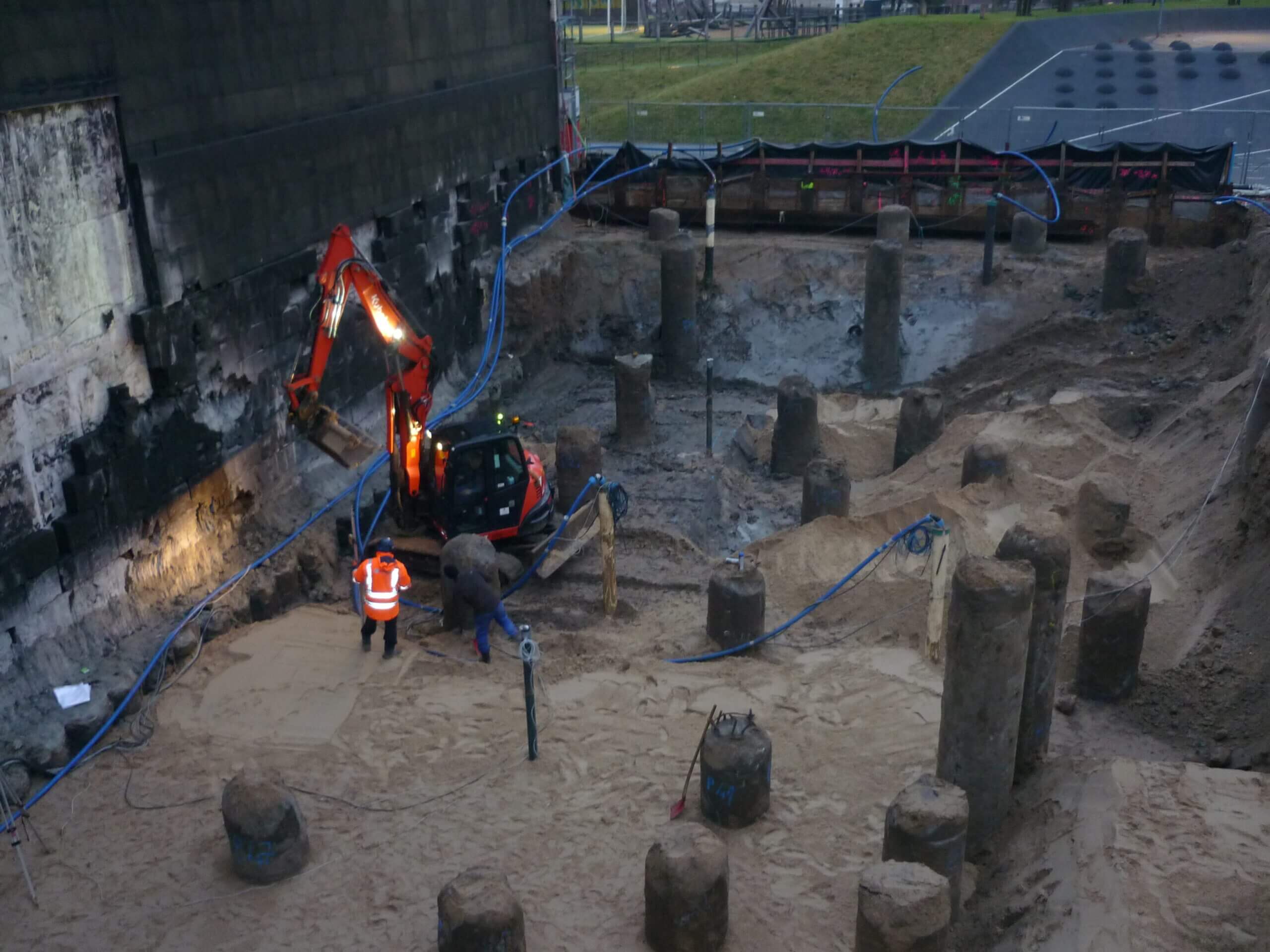
Ginger HPC was involved early on through subsoil investigations. Historical records indicated that this site previously housed a tar storage facility for the Hamburg port, meaning that old foundation remnants and contamination were to be expected. This was confirmed during excavation.
The foundation remnants turned out to be deeply buried, massive brick masonry blocks on timber piles. A grid-based preliminary investigation carried out before excavation already revealed:
Due to heavy contamination, parts of the soil had to be classified as hazardous waste. For the excavation, Ginger HPC implemented a comprehensive electronic waste documentation procedure (eANV). This ensured that every step—from material identification to transport and final disposal at a landfill—was fully documented digitally. Due to the varying contamination levels in the soil layers, precise soil management was essential, particularly in separating soils from construction debris.
At a glance:
The immediate proximity to the Elbe, whose tidal water levels in Hamburg fluctuate by more than 3.6 meters several times a day, presents a number of challenges. For example, the tides influence the groundwater level, which is therefore also subject to regular fluctuations. As a result, old foundations could only be gradually replaced with sand during low tide conditions to prevent water ingress and soil erosion.
To ensure safe working conditions, Ginger HPC regularly produced water level forecasts. These were used to define time windows during which excavation work could be carried out at low tide. For deeper excavation of the construction pit, including up to two basement levels, groundwater lowering was required. This had to be carefully regulated in line with the constantly rising and falling groundwater levels.
As flood protection coordinator, Ginger HPC also developed a comprehensive flood protection concept:
At a water level of 4.4 meters, the construction pit would be flooded from above by the Elbe, making protective measures and precise forecasts essential. Ginger HPC focused on several key criteria: ensuring the safety of people and machinery, and preventing contamination of the Elbe. To achieve this, a dedicated on-call team produced storm surge forecasts at least twice a week and defined corresponding measures. For example, once certain Elbe water level thresholds were expected to be exceeded, building materials were moved to flood-safe elevations or work was temporarily halted.
“Flood protection measures cost time and money—but our top priority is that people, machinery, and the environment are not harmed.”
Gerson Schramm
Logistics in confined spaces
A major challenge in this project is the limited space and accessibility. On both the western and eastern sides, the daycare building directly borders neighboring buildings still under construction. To the north and south, the construction pit adjoins public areas: on one side, there is a tartan track where neither construction vehicles can drive nor materials can be stored. On the other side, the only site access is a one-way street with adjacent cycling and pedestrian paths. This means that extensive work, such as excavation, must be managed within a one-way traffic system.
This creates significant logistical challenges, particularly when installing the water treatment system required for groundwater lowering. Due to the limited space around the construction pit, the system was installed 250 meters away on a nearby undeveloped plot. A complex task in which Ginger HPC was closely involved in both planning and execution. This contributed significantly to preventing contamination of the Elbe and the groundwater.
In the meantime, the structural buoyancy of the new building is ensured through its own weight and additional loads, allowing the groundwater management system to be successfully dismantled.
Looking ahead: sustainability for the future
The southern retaining structure is planned to be backfilled under the professional supervision of Ginger HPC using liquid soil up to 1.5 meters below ground level. The sandy fill above will be installed using water flushing techniques, while the timber sheeting will be gradually removed.
Finally, public areas such as roads, sidewalks, and cycle paths, as well as infrastructure like wastewater and stormwater pipelines, will be inspected through comprehensive elevation measurements, compaction testing, and CCTV inspections. Ginger HPC is responsible for planning and initiating these verification measures, carrying them out in part, and evaluating the results.
It remains an exciting project for Ginger HPC: following the successful excavation of the construction pit, structural works are now in full swing. Our team of experienced engineers continues to provide expert support for these construction activities, particularly in geotechnical and environmental matters.
One of the next tasks is the dismantling of the excavation support system—a combination of a braced Berlin-type retaining system on the north side and a double-anchored Essen-type retaining system on the south side. The extremely limited space in the construction pit’s side areas (in some places only around 10 cm between the new structure and the soldier pile wall) presents particular challenges, especially on the south side when backfilling the approximately 5-meter-deep area.
More success stories


Why work with us?
More than 75 years of experience
Since 1948, Ginger HPC has combined expertise and precision in environmental and engineering projects – ensuring reliable solutions that stand the test of time.
Strong international network
With offices across Europe, as part of the Ginger Group and as a founding member of the Inogen Alliance, we bring global insights and local expertise to every project.
Award-winning sustainability
From international certifications to industry awards, our achievements reflect engineering precision, high standards, and a continuous drive for innovation.
Our Service Areas
Land Recycling
Experience. Responsibility. Worldwide.
Life is constantly evolving. New buildings and installations are emerging on freely available land. Elsewhere occupied land is being redeveloped and…

Environment and Safety
Experience. Responsibility. Worldwide.
The environment and our living conditions determine our quality of life. Development entails changes. Sustainable environmental development is the…
Infrastructure
Experience. Accountability. Valorisation.
Regional economic objectives of investment-related infrastructure policies can only be achieved by thorough infrastructure planning. Infrastructure…
Got a project in mind?
We have the solution.